Post: Closing
I want to close up on my opinion of President Macron. I do not hate the man. Now, I do dislike his politics and character though. I would separate the character from hating him as a person still though because it is based more on the position he sits in and less about some heinous acts he has committed or the like.
To explain, he is in some debt…allegedly. The man came onto the political stage from seemingly nowhere, won the presidential race without any prior political history, and seems to have a shady past. There was a few exposés written about his supposed bank owning funders. Whether you believe them or not, the truth that presidential campaigns are incredibly expensive, especially for those who do not even have their name in the public sphere up until the moment of announcing candidacy, remains. It is evident that some organization or individual was integral to his funding and unexpected rise from nothing-banker to President of the French Republic. For the same concerns that Americans had that Donald Trump was in some way financially owned by a foreign entity during the whole tax document scandal, I am worried on behalf of the French as to who the man owes a great debt. The secrecy surrounding it and constant raising or arbitrary taxes demonstrates poor character to me. Whether or not he is intending wrongdoing is irrelevant because he has carried himself until now in such a suspicious manner. Obviously, considering seventy-odd weeks of continuous protest, I am not in the minority here.
On the other hand there is his politics. Don’t like em, never will. I do not consider myself, in the American sphere, a Republican or Democrat. I dislike republicanism too. France as a state is just not the ideal to me, and his attempts to raise taxes in a nation with upwards of 60% income tax is a philosophy with which I take issue. Furthermore, the gas taxes that started all of this madness were not to solve an issue as much as to discourage the use of fossil fuels. Coercion is not my style. The current hot topic that he is under criticism for is his dealing with the pension system changes. I actually vehemently disagree with the idea of pensions YET I do not have a record of decision making that paints me as anti-American. The man literally told the Danish Prime Minister that there is no such thing as a true Frenchman and that the current French constituency is too stubborn for change. Whether you agree or disagree about the significant nationalism should play, it is undeniable to say that insulting your own people is unacceptable as a leader. Especially because France is one of the most progressive nations on the planet. Its socialist leanings are far more pronounced than any other European power and from green energy to social justice, France has clearly made the greatest attempts at change. It is a boldface lie and therefore egregious insult to say they are too stubborn for change.
I believe, as well, that he used the term “Gaul” when describing them as stubborn. This only makes the situation worse and does more to show him as a foreign leader only there to extract resources, not at all someone to consider you brother. Gauls were the peoples of the land we now consider France about 2000 years ago when Roman expanded northward. To put it lightly, they were not treated the best by the Roman governors, who, for a great while, say the provinces as sacks of wealth waiting to be plundered. There are plenty of picture of yellow vests writing “Gaulois en colere” or “Angry Gauls” on their gear during demonstrations. It was clearly a message they took great offence from and I cannot find it in me to support a leader who clearly does not care for his people.
These protests will not stop soon, this much is clear. I just hope some good does indeed come out of it. Even if the complete dismantling of the French governing system is not achievable like the Gilets Jaunes are demanding, I hope all of this anger, violence, and division was not for naught.
Post: 4/30/2020 Follow-up
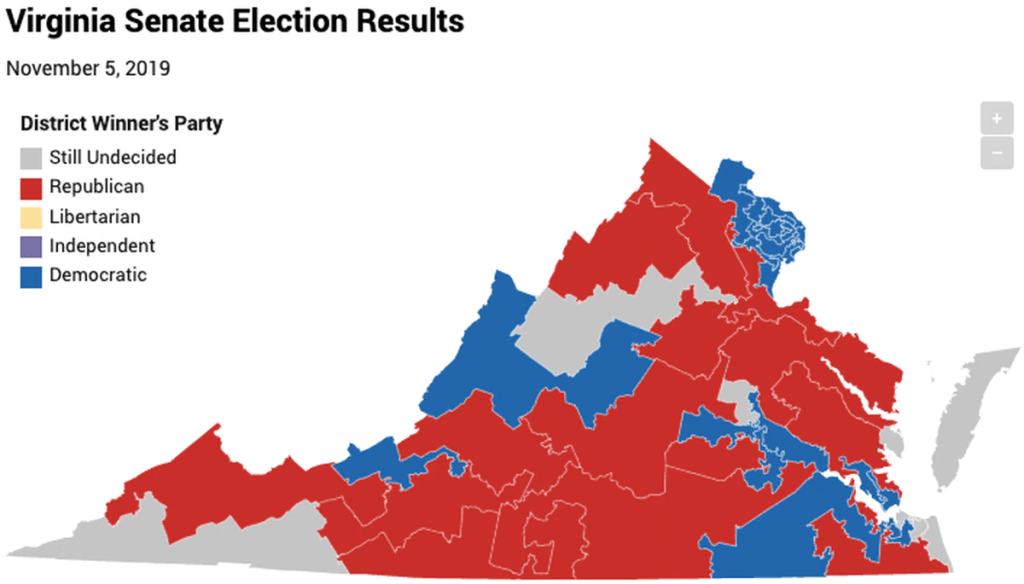
An important aspect of the protests that I should also note is their relation to the mayoral elections in France. On March 15 and 22 France held local elections for over ten thousand of its towns and villages. While, in the United States, we do not compare local elections to the likelihood of a party candidate winning the presidency, in France that is common practice. The most apt comparison would be to look at it on a smaller scale, such as the elections for state senator in Virginia being used as an indicator for who the governor will likely be. Here is a map of the state senator elections based on party affiliation:
Now here is a map of how each county voted during the gubernatorial election:
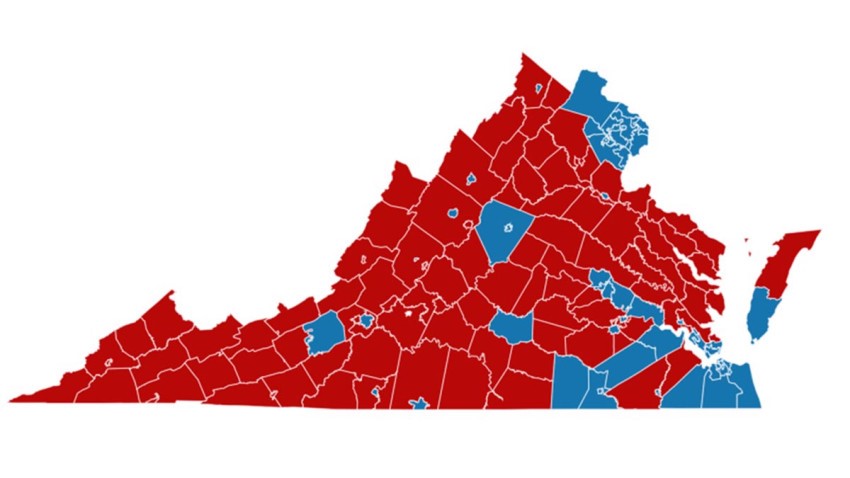
The senatorial races are a near perfect indicator for the larger election that same year. This is essentially how local elections are viewed in France. The main difference would be that France is very much a multiparty state with new parties coming and going quite frequently. I have heard political analysts…well…discourage this before, and I would tend to agree with them. At least from an outsider perspective, the French elections look messy and unpredictable for a great number of new and burgeoning parties. How does any of this relate to the protests?
Well The party of Macron (Rally National or RN) is only a few years old. Like Macron himself, the RN was conceived out of nowhere and suddenly took French politics by storm. This is not unprecedented in France like it would be in the United States since the French system was built for the sudden growth of a new party, but such parties can disappear as fast as they arrived. This seems to be the case with RN. Reading European headlines prior to the elections, it was difficult to come across even one that did not include the phrase “Macron to be punished in upcoming election.”
https://www.wsws.org/en/articles/2020/03/07/macr-m07.html
In reality, I would not say he was “punished” during these elections. His stance on the new pension plan is incredibly unfavorable and the obvious seventy weeks on continued protests did not help his case. But, the arrival of Corona certainly aided in his party treading water for at least another few months.
France saw its lowest voter turnout since the Fifth Republic in 1958, he held the elections at the predetermined date but leaving your home to actually vote was discouraged…take away what you will from that. This garnered even more criticism from the public and this is one of the few times I would actually side with Macron. The pandemic will only cripple a nation as much as we let it. If he postponed election I am sure that he would have been criticized for being a tyrant who keeps his former local election RN members in power despite their lack of popularity. It was a lose-lose situation for the man and I do feel bad for him.
Post: 4/29/2020
Much like the rest of Europe at the time and now the whole of the world, France responded to the growing threat of the pandemic by closing schools and urging citizens to stay indoors unless they had essential errands to complete.Here, in the United States, this was a large inconvenience at best and a reason to claim unemployment at worst. But, in France, there is a wholly different issue.
His address to the nation was made on Thursday March 12, the eve of the seventieth consecutive weekend of protests for the yellow vests. This was a significant problem because the government had banned gatherings of more than 100 people. Whether this was a use of the pandemic to attempt to ruin the protesters momentum them had built up in the past year and a half, I cannot say, but that is how they interpreted it. Major roadways and cultural centers were blocked off from public use and lined with armored police units. That was nothing new at this point considering this weekend would have been the anniversary of the worst violence of the entire movement, performed in Paris on the now closed Champs-Elysees. It seemed to the demonstrators that the president was attempting to use both the social pressure of being discouraged from close gatherings and the threat of heavy police measures to finally end the longest protest in French history. Yeah…didn’t work.
The protests, albeit much smaller, continued against government mandates. In Paris, they congregated outside the Montparnasse train station to chant their anti-Macron slogans. Most wore protective masks, as recommended in the United States now. But these demonstrators had been enduring tear gas attacks for more than a year now so many already used this gear during protest times to begin with. Honestly, the amount of protective gear the yellow vests wore, it would be a difficult argument to say their gatherings furthered much of any disease spread.
Post: 4/21/2020
The Black Bloc has had a presence in French politics for some time before the populist rise of recent time. I believe it is important to mention, because it remains one of the most challenging issues for the Gilets Jaunes to overcome in the realm of public relations. Their actions are a stain on the reputation of the “peaceful Yellow Vest” and serve to only vilify an otherwise non-violent movement in the minds of the neutral French citizens.
The group is explicitly anarchist and could be best conflated with the American ANTIFA in both ideology and tactics. Now, ANTIFA is supposed to be a coalition of multi-ideological persons opposed to fascism but is almost exclusively made up of socialists and others of the same leftist caliber. Similarly, the Black Bloc contains the same concentration of leftist ideology, while claiming to be a coalition of rational persons who stand against police brutality, racial injustice, and the like. In practice, however, the Black Bloc has built up quite a negative reputation for itself. Vandalism and assault are a common tactic employed by its members, even if it is not explicitly taught to followers. It was common in the opening days of the Yellow Vest protest to find videos of black clad vandals torching cars, both police and civilian, smashing windows of shopfronts and residential buildings, and attacking police with throwables or smaller items before fleeing into large manifestations.
I want to stress the importance of separating the actions of the Black Bloc from that of the non-violent protesters. They do not represent the ethos or tactics stated by the leadership of the Gilets Jaunes and are better forgotten than taken seriously. I would be more open to labeling the Black Bloc as a terrorist organization than one seeking justice and a fair chance on the political stage.
Post: 4/16/2020
This is going to function a little differently to the past updates on Yellow Vest protests. I want to focus a bit more on the background and underlying sentiment of the demonstrators: populism. Populism focuses on the betterment of “ the people” as its root would suggest, but it’s a particular sect of society: the poor. Populist movements assert that there is a growing, expansive divide between the lower and upper echelons of society that has become so great as to cause disaster for those not among the elite. This has been a growing political trend across the world, not just in France. Take the election of Matteo Salvini in Italy, resignation of Angela Merkal in Germany, Brexit, election of Donald Trump, and election of Victor Orban in Hungary as shining examples of populist rhetoric becoming mainstream today. The Yellow Vests do not claim to be affiliated with the left or right as a whole, but there are of course sects leaning to both sides. They are all united in a general belief that no matter their liberal or conservative swaying, the establishment does not operate in the interest of the majority of the population. They seem to have set aside most, if not all, party squabbles to create a united, centrist front founded on anti-elitism.
Post: 3/22/2020
The spread of yellow vest protests is surly something to keep an eye on. Stories of protests across Europe turning into yellow vest rallies has been a constant phenomenon over the last two years. The reception of this though, has varied drastically. In Russia for example, the policing of sudden yellow vest demonstrations was described as “heavy handed” with, allegedly, hundreds of demonstrators arrested in a single day in Saint Petersburg. Developments are building and will likely boil over into something dangerous soon.
Post: 3/2/2020
So, its been a little while since the last post. This, however, has been intentional as I have been waiting for things in the recent acts 67 and 68 to develop.
Things have been tame as of late, relatively. Violence is still a constant during weekend demonstrations but nothing more volatile than what I have previously wrote about has occurred. Last weekend, protests in Lille caught much attention and this weekend its Strasbourg that has caught the eye of the French media.
The most notable of changes (and honestly one of the only demonstrable developments as of late) would have to be the growing, explicit anti-police sentiment among demonstrators. This should not come as a surprise by this point, seeing the number of eyes and limbs lost at the hands of the security forces. But never were there protestors specifically demonstrating on a large scale, with the express intention of voicing anti-police sentiment like in the United States.
Truthfully, we will just have to hold tight and watch this feeling closely over the next few weeks to know whether action against police will become a tenant in the gilet jaune philosophy.
Post: 2/19/2020
It seems that the video that previously surfaced depicting officers violently arresting a French protester has had considerable effect on the moral of anti-police and anti-police brutality movements across France. It has reinvigorated those who claim the national police are too harsh on protesters and only served as negative media for the French government.
In other news, there seems to be a re-invigoration of the anti-capitalists in France as well. BlackRock, a US money management company working in Paris, has recently become the focus of anti-capitalist sentiment in the nation. Gilets jaunes claim that the company stand to profit greatly from the new economic plans of the French president and thus should be targeted for protest. Their headquarters in Paris was mobbed by the French equivalent of ANTIFA and gilets jaunes this past weekend. These anti-capitalists are not gilet jaune entirely, as they have considerable numbers of black bloc hooligans in their ranks. I am, personally, no fan of the black bloc. These are the individuals you will see in most videos depicting vandalism. They destroy shop fronts and torch cars as a staple of their movement. Much like the ANTIFA cowards of the United States, they hide their faces and wear all black like discount vigilante superheroes. We will have to see if their violence escalates amid “Acte 66” this weekend.
Post: 2/11/2020
The video of the confrontation:
It seems like France has not gotten any better…
A video surfaced this weekend of a physical altercation between the French police and activists. With nearly three million views, this video has become a focal point for the anti-police sentiment in France. Over the course of the Gilet Jaune protests, a myriad of violent videos came to light, but it seems that sixty weeks has not been enough time for a decline in violence and easing of tensions. That, in essence, is the most jarring part about this entire situation. It was unsettling, but not surprising, to hear of violence in the opening weeks of this movement, when entire French cities were being destroyed by a subsect of the protestors. But now, seeing a video of a man being singled out and beaten by police, it feels as if it has gone on too long.
I implore everyone to watch the video for themselves before reading my analysis of it, as to not taint your perception of the events. The following, however, is an objective description of what occurred:
The video begins with a riot officer walking towards a line of protesters standing against a shop front. The officer is pointing at a man and looking back towards another officer who seems to be giving him directions, shouting, “A gauche, a gauche!” Upon hearing this, the original officer points to the protester to the left of him and the second officer charges the same man. The man raises his hands and the second officer initiates a takedown as the original officer strikes the man with a kick to the groin area. The statement offered after by French police cites that the man who was struck by police had been sighted throwing rocks at riot officers earlier that day. The security forces asserted that the man had fled police capture, as he had thrown rocks at them, which is an arrestable offence in France, and that this video omits the context which justifies the violent action.
Now my analysis will begin, so make sure you have watched the video to your satisfaction.
This seems credible to some degree. I say this because the officers clearly did not choose the man at random, the original officers was clearly receiving directions from the second officer as his shouting “A gauche” was a command to select the man to the left of the one to which original officer was already pointing. It is evident that there was a purposeful search going on that was initiated prior to the assembling of the protestors in a line. Whether or not this man was guilty of throwing rocks earlier in the day, I do not think the violent takedown is excusable. The man raised his hands; however, it seems he only took a defensive position after the second officer charged him. There is no evidence of a peaceful attempt to arrest this unarmed man. I do not believe that it is unreasonable for a man, guilty or innocent of prior crimes, to be defensive when charged at. There was no attempt by the security forces to initiate a peaceful arrest once the suspect had been sighted. I know in the United States this man would have a very strong case to make against the police on the grounds of excessive force.
Post: 02/03/2020
The movement itself began in October of 2018. The President of France announced a tax increase on gasoline and, putting it lightly, France broke down. Suddenly, in one weekend, hundreds of thousands of protestors across the entirety of the country took to the streets wearing the iconic yellow vests. These garments are mandated to be kept in vehicles to be used in emergencies, but they soon became a symbol that could unite men and women across the country with seemingly nothing else in common. Considered to be the largest protest in French history since the student protests of the 60s, the power and scope of these demonstrations were immediately felt by the powerful and wealthy of France. It is important to remember that this power has not waned over the last year either. Currently the longest continuous protest in French history, hundreds of thousands continue to show their solidarity with the cause. In fact, the protest of French workers this past month was headed by demonstrators all sporting that yellow vest.
These protests began, and still are, unaffiliated with any particular political party or sponsor. While a pseudo-leadership has emerged from amongst the protesters, for the past sixty odd weeks, they have held firm that this movement goes beyond any contemporary political ideology. They believe that there is no government structure currently in France that could even be reformed to meet their needs. In other words: the political structure as we know it must be dissolved. What began as a reaction to fuel taxes has grown into a complete rejection of French governmental form.
This goes without saying, but the presidency of Macron since these protests began has been critically hindered by the persistence of the protests. Initially, the government and media worked together to present the protests as rather uneventful and isolated. But when hundreds of thousands are marching in the streets, tanks patrol Paris, rampant police beating are shared across the world, messages tend to get around. The tactics of the President shifted when playing down the demonstrations failed to stop the growth. In the early weeks of 2019, Macron addressed the development by accusing the demonstrators of being “the spokespeople of a hate-filled crowd attacking elected representatives, the forces of law and order, journalists, Jews, foreigners, homosexuals. That is simply the negation of France. I have recently seen things that are unthinkable and heard the unacceptable.” You can imagine how this turned out for his own popularity. If you do not have a vivid imagination, then let me paint a picture for you. Once hailed as the leftist savoir of France and righteous vanquisher of the evil crone Le Pen, Macron dragged an abysmal 15-17% approval rate, only to claw back a precious few percentage points in these recent months. It seems as if calling a movement consisting of men and women, gays and straights, blacks and whites, Catholics, Jews, and Muslims, a band of thugs who hate homosexuals is not a well-reasoned idea. Who would have thought? Of course, his slander had little to no discernable effect on the intensity of the protests, which continue with gusto to this day.
Next post will cover the protest of the past week. See you there.
 France on Fire